
Visualize Hand Motion metrics in Real Time
Explore biomechanics through skeletal tracking and spatial computing.
OrthoHand Motion reconstructs a skeletal model of the hand and displays motion metrics while the hand moves.Using camera-based tracking, the application visualizes finger movement, grip formation, and spatial motion patterns.
On Apple Vision Pro the experience becomes immersive, allowing users to explore hand motion in three-dimensional space.


 |  |  |  |
|---|---|---|---|
 |  |  |  |
 |  |  |  |
iPhone & iPad Version
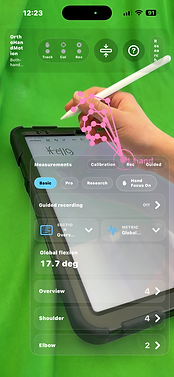
OrthoHand Motion visualizes hand movement in real time using camera-based skeletal tracking directly on your iPhone or iPad. The application reconstructs a digital skeletal model of the hand and performs approximately 140 real-time measurements, within a comprehensive framework of up to 179 algorithm-derived calculations, covering joint kinematics, spatial relationships, coordination patterns, and movement quality.
Using advanced computer vision, the system detects anatomical landmarks of the hand and calculates geometric relationships between them. These relationships are used to estimate motion parameters that update continuously as the hand moves, allowing dynamic visualization of movement in real time. The app provides a responsive and interactive interface where users can observe how motion evolves frame by frame.
Core measurements include finger joint angles (MCP, PIP, DIP), thumb motion (MCP, IP, opposition), finger spread and inter-digit relationships, grip aperture, pinch distance, and cascade alignment. Additional dynamic metrics include range of motion, angular velocity, acceleration profiles, motion timing, repetition rate, and movement consistency. The system also estimates symmetry between movements and provides motion quality indicators such as smoothness, coordination, and variability.
OrthoHand Motion is designed to function entirely using the device camera, without requiring external sensors, markers, or wearable hardware. This allows immediate accessibility while maintaining real-time performance and continuous feedback. Measurements are derived from visual tracking and represent estimated biomechanical parameters based on detected landmarks.
The application includes multiple modes to adapt to different levels of analysis. Basic mode provides core motion visualization metrics. Advanced modes enable extended analytics, including temporal and coordination measurements. Research-oriented functionality allows recording of motion sessions and export of time-series datasets, including timestamped values for further analysis.
Guided recording workflows provide structured motion tasks, helping users perform repeatable movement sequences. These guided protocols support consistent data capture and enable comparison between sessions. Recording and playback features allow users to review motion and observe changes over time.
OrthoHand Motion on iPhone and iPad is designed for education, biomechanics exploration, gesture analysis, XR interaction development, and research workflows. It provides an intuitive way to understand how the hand moves, how fingers coordinate, and how motion patterns change during tasks.
The system emphasizes visualization and interpretability rather than precision measurement. All outputs are generated through algorithmic estimation models and may vary depending on environmental conditions such as lighting, occlusion, camera angle, and tracking stability. Accuracy may also depend on hand visibility and positioning relative to the camera.
All processing occurs locally on the device. The application does not require external data transmission, does not collect personal information, and does not rely on cloud-based processing for motion estimation.
OrthoHand Motion is intended for visualization, education, and research purposes only. It does not provide medical diagnosis, treatment recommendations, or clinical decision support. All measurements should be interpreted as estimations and not as definitive biomechanical or clinical values.




Apple Vision Pro Version
OrthoHand Motion on Apple Vision Pro transforms hand motion analysis into a fully immersive spatial computing experience, enabling true three-dimensional visualization of hand biomechanics in real time.
The application reconstructs a floating skeletal model of the hand using native spatial hand tracking and performs approximately 140 real-time measurements, within a complete framework of up to 179 algorithm-derived kinematic calculations. These measurements span joint kinematics, inter-finger relationships, grip and pinch metrics, temporal dynamics, spatial trajectories, symmetry, and movement quality.
Unlike camera-based systems, Apple Vision Pro enables true 3D tracking in space, allowing the system to compute hand motion relative to a spatial coordinate system. This allows OrthoHand Motion to represent movement not only as joint angles, but as full spatial behavior.
Users can observe:
• Real-time 3D joint motion across all fingers
• True spatial orientation of the hand and palm
• Palm and carpal plane alignment in space
• Fingertip trajectories evolving over time
• Estimated six-degree-of-freedom (6DoF) hand pose
• Movement patterns relative to the environment
The hand appears as a floating, interactive model in immersive space. Users can move around it, change perspective, and observe motion from any angle, creating a deeper understanding of biomechanics that is not possible on a flat screen.
Measurements update continuously as the hand moves, and visualization elements are integrated directly into the spatial environment. Motion data is presented as overlays, trajectories, and dynamic indicators that respond in real time.
The system computes joint angles, distances, temporal metrics, and spatial relationships using detected hand landmarks. In addition to standard kinematic measures such as MCP, PIP, DIP flexion and thumb motion, the Vision Pro version enables advanced spatial metrics including trajectory analysis, orientation tracking, and coordinate system alignment.
Guided workflows support structured motion capture in immersive space, allowing users to perform repeatable tasks while observing motion feedback in real time. Recording features allow motion sessions to be captured and exported, enabling further analysis or research workflows.
Compared to iPhone and iPad, the Vision Pro experience provides:
• True 3D spatial tracking instead of 2D projection-based estimation
• Full 6DoF hand pose visualization
• Real trajectory visualization in space
• Interactive observation from any viewpoint
• Enhanced perception of motion coordination and depth
This makes OrthoHand Motion on Vision Pro particularly powerful for advanced biomechanics exploration, XR interaction research, immersive education, and spatial motion analysis.
The application operates entirely on-device and does not require external sensors or wearable hardware. All processing is performed locally, ensuring real-time performance and privacy.
All measurements are algorithm-derived estimations and may vary depending on tracking conditions, occlusion, and environmental factors. While spatial tracking improves representation of motion, outputs remain computational estimations rather than direct physical measurements.
OrthoHand Motion is intended for visualization, research, and educational use. It does not provide medical diagnosis, treatment recommendations, or clinical decision support. All outputs should be interpreted within the context of visualization and exploratory analysis.

Measurement System & Platform Differences
OrthoHand Motion performs approximately 140 real-time measurements within a framework of up to 179 algorithm-derived metrics. These include joint angles, distances, coordination patterns, timing, motion quality, and spatial movement analysis.
📱 iPhone & iPad (Camera-Based – Proxy Measurements)
On iPhone and iPad, measurements are derived from 2D/monocular camera-based landmark detection. Because depth is estimated rather than directly measured, some metrics are calculated as proxies.
A proxy measurement is an estimated biomechanical parameter derived from projected geometry and relative landmark relationships rather than true spatial coordinates.
Key characteristics:
-
Depth is inferred (not directly measured)
-
Angles are often computed in projected planes
-
Spatial orientation is approximated
-
Measurements remain consistent and responsive, but represent estimations
Metrics that are proxy-based or approximated on iOS:
-
Thumb CMC flexion and abduction
-
Thumb opposition angle (estimated relative to projected palm plane)
-
Wrist rotation (limited without full forearm tracking)
-
Palm and carpal orientation
-
3D segment orientation
-
6DoF hand pose (not true, only approximated)
-
Spatial trajectories (projected paths, not true 3D paths)
-
Some motion quality metrics affected by depth estimation
🥽 Apple Vision Pro (Spatial Tracking – True 3D Metrics)
On Apple Vision Pro, measurements are derived from native spatial hand tracking, enabling true 3D coordinate acquisition.
This allows direct computation of spatial relationships without projection assumptions.
Key advantages:
-
True 3D landmark positions
-
Accurate spatial orientation and rotation
-
Real trajectory tracking in space
-
Stable coordinate system definition
-
Full 6DoF hand pose
Metrics that are true (non-proxy) on Vision Pro:
-
Palm plane orientation
-
Carpal plane orientation
-
Wrist rotation and orientation
-
Thumb opposition in 3D space
-
3D segment orientation (Euler, axis-angle, quaternion)
-
Fingertip trajectories (true spatial paths)
-
Translation (X, Y, Z positions)
-
Full 6DoF hand pose (Tx, Ty, Tz, Rx, Ry, Rz)
-
Coordinate system metrics and alignment
-
Spatial motion quality metrics
⚖️ Summary of Differences
Category
iPhone / iPad
Apple Vision Pro
Tracking Type
Camera-based (2D + inferred depth)
Native spatial (true 3D)
Joint Angles
Accurate (projected)
Accurate (true 3D)
Distances (grip/pinch)
Approximate
True spatial
Orientation (palm/wrist)
Proxy
True
Trajectories
Projected
True 3D
6DoF Pose
Not available (approximation only)
Fully available
Coordinate System
Limited
Fully defined
Motion Quality
Good estimation
Higher fidelity
🧠 Interpretation
-
iOS version provides highly accessible, real-time motion estimation suitable for visualization, education, and general analysis.
-
Vision Pro version provides a true spatial biomechanics system, enabling deeper analysis of motion in 3D space.
Both platforms use the same measurement framework, but differ in how spatial information is derived.
⚠️ Important Note
All measurements across both platforms are algorithm-derived estimations based on tracked landmarks and should be interpreted as visualization and research metrics, not as direct physical measurements.
Please download Technical note to study further


OrthoHand Motion – Measurement Framework
OrthoHand Motion performs approximately 140 distinct real-time measurements, covering joint kinematics, spatial motion, coordination, and movement quality.
All 179 measurements are algorithm-derived estimations based on detected hand landmarks.
1. Joint Angle Metrics (20 measurements)
1 Index MCP flexion
2 Index PIP flexion
3 Index DIP flexion
4 Middle MCP flexion
5 Middle PIP flexion
6 Middle DIP flexion
7 Ring MCP flexion
8 Ring PIP flexion
9 Ring DIP flexion
10 Little MCP flexion
11 Little PIP flexion
12 Little DIP flexion
13 Thumb MCP flexion
14 Thumb IP flexion
15 Thumb CMC flexion proxy
16 Thumb CMC abduction proxy
17 Thumb opposition angle
18 Thumb palmar opening angle
19 Combined finger flexion index
20 Global joint flexion score
2. Inter-Finger & Opposition Metrics (10 measurements)
21 Index–Middle spread
22 Middle–Ring spread
23 Ring–Little spread
24 Thumb–Index opening
25 Thumb–Middle opening
26 Thumb–Ring opening
27 Thumb–Little opening
28 Global finger spread index
29 Inter-finger coordination angle
30 Abduction/adduction pattern index
3. Cascade & Posture Metrics (6 measurements)
31 Index cascade angle
32 Middle cascade angle
33 Ring cascade angle
34 Little cascade angle
35 Global cascade score
36 Cascade asymmetry index
4. Range of Motion Metrics (15 measurements)
37 Index MCP ROM
38 Middle MCP ROM
39 Ring MCP ROM
40 Little MCP ROM
41 Index PIP ROM
42 Middle PIP ROM
43 Ring PIP ROM
44 Little PIP ROM
45 Index DIP ROM
46 Middle DIP ROM
47 Ring DIP ROM
48 Little DIP ROM
49 Thumb MCP ROM
50 Thumb IP ROM
51 Global hand ROM
5. Velocity & Acceleration Metrics (12 measurements)
52 MCP angular velocity
53 PIP angular velocity
54 DIP angular velocity
55 Thumb angular velocity
56 Peak closing velocity
57 Peak opening velocity
58 Mean angular velocity
59 MCP angular acceleration
60 PIP angular acceleration
61 DIP angular acceleration
62 Peak acceleration
63 Movement acceleration profile
6. Timing Metrics (8 measurements)
64 Movement onset time
65 Time to full flexion
66 Time to extension
67 Grip cycle duration
68 Repetition rate
69 Inter-finger delay
70 Thumb contact timing
71 Motion phase timing
7. Wrist / Palm / Carpal Metrics (10 measurements)
72 Wrist flexion
73 Wrist extension
74 Radial deviation
75 Ulnar deviation
76 Wrist rotation proxy
77 Palm pitch
78 Palm yaw
79 Palm roll
80 Palm plane orientation
81 Carpal plane orientation
8. 3D Segment Orientation (10 measurements)
82 Index segment orientation
83 Middle segment orientation
84 Ring segment orientation
85 Little segment orientation
86 Thumb segment orientation
87 Distal phalanx orientation
88 Proximal phalanx orientation
89 Orientation Euler angles
90 Orientation axis-angle
91 Orientation quaternion
9. Translation & Position Metrics (8 measurements)
92 Wrist X position
93 Wrist Y position
94 Wrist Z position
95 Fingertip positions
96 Palm center position
97 Hand centroid
98 Spatial displacement
99 Relative movement
10. Trajectory Metrics (6 measurements)
100 Fingertip trajectory length
101 Thumb trajectory length
102 Wrist trajectory
103 Trajectory curvature
104 Path efficiency
105 Trajectory consistency
11. Distance Metrics (15 measurements)
106 Thumb–Index distance
107 Thumb–Middle distance
108 Thumb–Ring distance
109 Thumb–Little distance
110 Index–Middle distance
111 Middle–Ring distance
112 Ring–Little distance
113 Fingertip–palm distance
114 Fingertip–wrist distance
115 MCP span
116 Palm width
117 Hand opening span
118 Grip aperture
119 Pinch aperture
120 Finger spread distance
12. Closure / Grip Metrics (6 measurements)
121 Thumb–Index pinch score
122 Thumb–Middle pinch score
123 Precision grip score
124 Power grip score
125 Hook grip score
126 Global closure score
13. Symmetry Metrics (10 measurements)
127 MCP symmetry
128 PIP symmetry
129 DIP symmetry
130 Thumb symmetry
131 Wrist symmetry
132 Cascade symmetry
133 Grip symmetry
134 Timing symmetry
135 Velocity symmetry
136 Global symmetry score
14. Motion Quality Metrics (10 measurements)
137 Motion smoothness
138 Jerk score
139 Tremor proxy
140 Variability score
141 Coordination score
142 Sequencing score
143 Consistency score
144 Stability score
145 Tracking confidence
146 Motion confidence index
15. Task-Specific Metrics (8 measurements)
147 Open–close task score
148 Pinch task score
149 Opposition task score
150 Finger tapping rate
151 Sequential touch score
152 Hold stability score
153 Gesture completion score
154 Task performance index
16. 6-DoF Hand Pose (6 measurements)
155 Tx
156 Ty
157 Tz
158 Rx
159 Ry
160 Rz
17. Coordinate System Metrics (8 measurements)
161 Local X axis
162 Local Y axis
163 Local Z axis
164 Axis alignment
165 Carpal normal
166 Calibration stability
167 Frame consistency
168 Reprojection consistency
18. Composite Research Scores (10 measurements)
169 Hand mobility index
170 Dexterity index
171 Grip efficiency score
172 Coordination score
173 Motion efficiency
174 Movement complexity
175 Symmetry index
176 Global flexion score
177 Global extension score
178 Kinematic richness score
---
Scientific Appendix
OrthoHand Motion Measurement Framework
1. Joint Angle Metrics
Reference range for this category
For finger joints, the best published functional reference for daily activity is approximately MCP 19°–71°, PIP 23°–87°, and DIP 10°–64°. A simpler functional posture reference is 61° MCP, 60° PIP, and 39° DIP. For the thumb, healthy full ROM is roughly 60° MCP flexion, 88° IP flexion, and Kapandji opposition grade 9–10. ([PubMed][1])
1. Index MCP flexion — bending at the index knuckle; important for grasp initiation, button pressing, keyboard use, XR pinch preparation, and trigger timing. Reduced values may indicate stiffness, pain avoidance, tendon dysfunction, or guarded movement.
2. Index PIP flexion — bending at the middle index joint; often a major contributor to closing around small objects. Low values can impair pinch shaping, pen grip, and fine manipulation.
3. Index DIP flexion — bending at the distal index joint; relevant to fingertip conformity and precision contact. Limited DIP motion often affects delicate pinch and touch accuracy.
4. Middle MCP flexion — central digit knuckle flexion; contributes to power grip symmetry and keyboard/game controller load distribution.
5. Middle PIP flexion — typically one of the strongest contributors to rapid finger closure. A deficit can make the hand look stiff even when MCP motion is preserved.
6. Middle DIP flexion — distal shaping of the middle finger; useful for precision grasp and fingertip contour matching.
7. Ring MCP flexion — ring finger proximal bend; often informative in grasp synergy and ulnar-side contribution during cylindrical grip.
8. Ring PIP flexion — ring finger middle-joint closure; useful in grip completeness and cascade analysis.
9. Ring DIP flexion — distal ring finger control; useful in coordinated release and shaping of the hand arc.
10. Little MCP flexion — little-finger knuckle bend; strongly linked to ulnar grasp contour and hand cupping.
11. Little PIP flexion — helps the ulnar side wrap around larger objects; often important in power grip and instrument control.
12. Little DIP flexion — distal closure on the ulnar border; supports full hand closure and natural cascade.
13. Thumb MCP flexion — proximal thumb bend; key in pinch shaping and tool stabilization.
14. Thumb IP flexion — distal thumb bend; especially relevant for precision pinch and small-object handling.
15. Thumb CMC flexion proxy — estimated base-of-thumb flexion; supports the thumb’s ability to come across the palm.
16. Thumb CMC abduction proxy — estimated opening of the thumb away from the palm; useful for grasp setup and object accommodation.
17. Thumb opposition angle — how effectively the thumb approaches or crosses toward the fingertips/palm; highly relevant for dexterity.
18. Thumb palmar opening angle — thumb opening relative to the palm plane; reflects workspace for grasp preparation.
19. Combined finger flexion index — a summary of flexion across digits; useful as a one-number grasp state indicator.
20. Global joint flexion score — composite bending score of the hand; useful for overviews, dashboards, and trend monitoring.
Clinical / practical meaning: joint angles are the core language of hand kinematics. They matter in education, tendon/arthritis monitoring, hand exercise feedback, ergonomic testing, XR hand-input research, music performance, and gaming dexterity. In pianists, inter-joint coordination and independence are especially relevant; in XR and gaming, these angles define gesture recognizability and fatigue-sensitive control quality. ([PMC][3])
---
2. Inter-Finger and Opposition Metrics
Reference interpretation
There is no single universal normal value for spread/opening angles across all tasks. These are best interpreted by task context, symmetry, and whether the hand can scale aperture appropriately to the target object or gesture. In healthy grasping, hand aperture and finger pre-shaping change systematically with task demands. ([PMC][4])
21. Index–Middle spread — angular separation of index and middle digits; reflects radial-side abduction control.
22. Middle–Ring spread — separation of central digits; useful in keyboard reach and hand opening symmetry.
23. Ring–Little spread — ulnar-side spread; important for cupping and broad-hand gestures.
24. Thumb–Index opening — classic precision-grip opening pair; critical for pinch and small-object approach.
25. Thumb–Middle opening — broader pinch/opening relationship; useful when the index is not the main working digit.
26. Thumb–Ring opening — measures more transverse opening; useful in larger object shaping.
27. Thumb–Little opening — reflects extreme opposition/adduction span across the palm.
28. Global finger spread index — one-number estimate of overall digit separation.
29. Inter-finger coordination angle — how consistently adjacent digits move together or apart.
30. Abduction/adduction pattern index — summary of how the hand opens and closes side-to-side.
Why it matters: these metrics are especially useful in gesture recognition, musical fingering, controller ergonomics, XR pinch gesture robustness, and differentiating precision grip from broader hand opening. Thumb opening and opposition are also major contributors to manual dexterity. ([PubMed][5])
---
3. Cascade and Posture Metrics
Reference interpretation
A normal resting hand shows a progressive cascade from index toward little finger. There is no single cutoff angle for every person, but asymmetry or a broken cascade is often more meaningful than the absolute number. Hand kinematics literature consistently treats posture synergies as clinically informative. ([PMC][6])
31. Index cascade angle — how much the index contributes to the resting/flexed cascade.
32. Middle cascade angle — central cascade contribution.
33. Ring cascade angle — ring-finger participation in natural hand curvature.
34. Little cascade angle — ulnar-end curvature contribution.
35. Global cascade score — summary of overall hand curvature.
36. Cascade asymmetry index — degree of disruption in the expected progression across digits.
Why it matters: useful in resting posture analysis, fatigue, post-injury screening, piano hand shape, and XR avatar realism.
---
4. Range of Motion Metrics
Reference range
Use the same finger functional ranges as above for task-relevant interpretation: MCP 19°–71°, PIP 23°–87°, DIP 10°–64°. For the thumb, healthy full ROM averages roughly 60° MCP flexion and 88° IP flexion. ROM is often more informative as max–min excursion during a standardized task than as a single static posture. ([PubMed][1])
37. Index MCP ROM — excursion of index MCP over time.
38. Middle MCP ROM — excursion of middle MCP.
39. Ring MCP ROM — excursion of ring MCP.
40. Little MCP ROM — excursion of little MCP.
41. Index PIP ROM — excursion of index PIP.
42. Middle PIP ROM — excursion of middle PIP.
43. Ring PIP ROM — excursion of ring PIP.
44. Little PIP ROM — excursion of little PIP.
45. Index DIP ROM — excursion of index DIP.
46. Middle DIP ROM — excursion of middle DIP.
47. Ring DIP ROM — excursion of ring DIP.
48. Little DIP ROM — excursion of little DIP.
49. Thumb MCP ROM — excursion of thumb MCP.
50. Thumb IP ROM — excursion of thumb IP.
51. Global hand ROM — combined excursion across the active joints.
Clinical / practical meaning: ROM reflects mobility reserve. It is central to exercise tracking, task reproducibility, gaming fatigue analysis, instrument technique, and rehabilitation-style observation, though your app should keep the latter framed as non-diagnostic visualization. PIP ROM often dominates fast grip-release patterns. ([PMC][7])
---
5. Velocity and Acceleration Metrics
Reference interpretation
There is no universal normal velocity or acceleration for all users because these depend strongly on age, task, tempo, instruction, and expertise. The main scientific interpretation is comparative: faster is not always better; what matters is task-appropriate speed with stability and low unnecessary variability. Finger sequence and peak velocity are established kinematic descriptors. ([PMC][7])
52. MCP angular velocity — speed of MCP angle change.
53. PIP angular velocity — speed of PIP angle change.
54. DIP angular velocity — speed of DIP angle change.
55. Thumb angular velocity — speed of thumb motion.
56. Peak closing velocity — fastest closing phase.
57. Peak opening velocity — fastest opening phase.
58. Mean angular velocity — average speed over the movement.
59. MCP angular acceleration — rate of change of MCP speed.
60. PIP angular acceleration — rate of change of PIP speed.
61. DIP angular acceleration — rate of change of DIP speed.
62. Peak acceleration — highest burst of speeding up.
63. Movement acceleration profile — shape of acceleration over time.
Why it matters: these metrics are useful for fast repetitive tasks, gaming, finger tapping, musical tempo control, and XR interactions where latency and command intention are important.
---
6. Timing Metrics
Reference interpretation
Timing metrics have task-specific normals, not universal ones. Finger tapping literature confirms that tapping rate and variability differ with age, sex, finger used, and task duration; opposition-sequence tests also have age- and sex-specific normative data. ([PubMed][8])
64. Movement onset time — delay from cue/start to detectable motion.
65. Time to full flexion — duration until maximal closure.
66. Time to extension — duration until reopening.
67. Grip cycle duration — full close-open cycle time.
68. Repetition rate — number of cycles per unit time.
69. Inter-finger delay — lag between digits during coordinated movement.
70. Thumb contact timing — timing of thumb arrival in pinch/opposition.
71. Motion phase timing — proportions of planning, opening, closing, and release.
Why it matters: timing is essential in piano, gaming, gesture sequencing, human-computer interaction, and any standardized task protocol.
---
7. Wrist, Palm, and Carpal Metrics
Reference range
Healthy full wrist ROM is roughly 73° flexion, 71° extension, 19° radial deviation, 33° ulnar deviation. Functional wrist ROM for many daily tasks is lower—roughly 40° flexion, 40° extension, and 40° combined radial-ulnar deviation. For palm and carpal orientation, there is no universal normal because orientation depends on task and calibration frame. ([PubMed][9])
72. Wrist flexion — bending palmward.
73. Wrist extension — bending dorsally.
74. Radial deviation — wrist movement toward thumb side.
75. Ulnar deviation — wrist movement toward little-finger side.
76. Wrist rotation proxy — estimated rotational component when forearm data are limited.
77. Palm pitch — palm tilt up/down relative to reference frame.
78. Palm yaw — palm turning left/right.
79. Palm roll — palm axial rotation.
80. Palm plane orientation — orientation of the palm plane in space.
81. Carpal plane orientation — orientation of the hand base/carpal reference frame.
Why it matters: this category is crucial in tool use, piano ergonomics, gaming posture, grip strategy, and Vision Pro spatial hand presentation.
---
8. 3D Segment Orientation Metrics
Reference interpretation
There is no single universal “normal” orientation because orientation depends on gesture and task. The scientific value lies in segment-to-segment relationships, repeatability, and alignment to a calibrated hand frame. 3D orientation is especially meaningful in immersive spatial computing. ([PMC][10])
82. Index segment orientation — 3D direction of the index segment.
83. Middle segment orientation — 3D direction of the middle segment.
84. Ring segment orientation — 3D direction of the ring segment.
85. Little segment orientation — 3D direction of the little-finger segment.
86. Thumb segment orientation — 3D direction of the thumb segment.
87. Distal phalanx orientation — direction of distal finger segments.
88. Proximal phalanx orientation — direction of proximal finger segments.
89. Orientation Euler angles — segment orientation expressed in pitch-yaw-roll style.
90. Orientation axis-angle — orientation expressed around an axis by an angle.
91. Orientation quaternion — robust mathematical orientation representation.
Why it matters: highly relevant for XR avatars, gesture engines, robotic teleoperation concepts, and immersive educational visualization.
---
9. Translation and Position Metrics
Reference interpretation
Absolute position metrics do not have universal normal values; interpretation depends on the workspace and sensor. Studies of markerless hand tracking show that tracking precision and stability vary with workspace location, so position metrics should be interpreted together with confidence and sensor geometry. ([PMC][10])
92. Wrist X position — left-right wrist position in the calibrated frame.
93. Wrist Y position — up-down wrist position.
94. Wrist Z position — depth position.
95. Fingertip positions — 3D coordinates of fingertips.
96. Palm center position — 3D coordinate of palm center.
97. Hand centroid — averaged center of the hand configuration.
98. Spatial displacement — amount of movement from baseline or previous frame.
99. Relative movement — positional change relative to another point or segment.
Why it matters: these are central for XR placement, trajectory replay, workspace analysis, and gesture-path studies.
---
10. Trajectory Metrics
Reference interpretation
Trajectory metrics usually lack universal normal cutoffs. Their meaning comes from efficiency, curvature, consistency, and task dependence. Reach-to-grasp research treats trajectory smoothness and aperture timing as meaningful markers of motor planning and control. ([PMC][11])
100. Fingertip trajectory length — total path traveled by a fingertip.
101. Thumb trajectory length — total thumb-tip path.
102. Wrist trajectory — path of the hand base through space.
103. Trajectory curvature — how straight or curved the path is.
104. Path efficiency — closeness to the shortest useful path.
105. Trajectory consistency — repeatability across repeated trials.
Why it matters: valuable in gesture design, XR interaction studies, motor learning, music technique, and gaming economy of motion.
---
11. Distance Metrics
Reference interpretation
Distance metrics such as grip aperture and pinch aperture depend on hand size and task. Healthy movement research treats their scaling to object size and timing as more important than a single fixed number. ([PMC][4])
106. Thumb–Index distance — classic precision-pinch aperture.
107. Thumb–Middle distance — alternate pinch span.
108. Thumb–Ring distance — broader cross-palm span.
109. Thumb–Little distance — extreme opposition span.
110. Index–Middle distance — radial pair spread.
111. Middle–Ring distance — central spread.
112. Ring–Little distance — ulnar spread.
113. Fingertip–Palm distance — how far a fingertip is from the palm center.
114. Fingertip–Wrist distance — global extension/flexion reach of a finger.
115. MCP span — distance across metacarpal heads.
116. Palm width — width proxy of the hand base.
117. Hand opening span — total opening across the hand.
118. Grip aperture — distance between the principal working digits, often thumb and index.
119. Pinch aperture — thumb-to-finger pinch gap.
120. Finger spread distance — linear analog of spread angle.
Why it matters: extremely intuitive for users; useful in pinch training demos, gamer hand opening, musical reach, robotic grasp analogies, and XR object interaction.
---
12. Closure and Grip Metrics
Reference interpretation
These are mostly derived task scores, so there is usually no universal normal threshold. Interpretation depends on whether the hand can form the intended grip pattern smoothly, symmetrically, and repeatably. Precision grip and whole-hand grip have distinct kinematic profiles. ([PMC][12])
121. Thumb–Index pinch score — quality/degree of classic precision pinch closure.
122. Thumb–Middle pinch score — alternate precision closure.
123. Precision grip score — composite for small-object grasping strategy.
124. Power grip score — composite for whole-hand cylindrical/spherical closure.
125. Hook grip score — composite emphasizing finger flexion with less thumb role.
126. Global closure score — summary of how fully the hand has closed.
Why it matters: useful for everyday grasp taxonomy, tool use, instrument fingering, gaming controller hold, and XR virtual object grasp classification.
---
13. Symmetry Metrics
Reference interpretation
Healthy hands are not perfectly identical, so the best reference is often small asymmetry rather than zero difference. A side-to-side comparison is especially valuable when the same standardized task is performed bilaterally. Symmetry has no single universal cutoff across all ages and tasks. ([PMC][13])
127. MCP symmetry — left-right similarity of MCP behavior.
128. PIP symmetry — left-right similarity of PIP behavior.
129. DIP symmetry — left-right similarity of DIP behavior.
130. Thumb symmetry — bilateral thumb similarity.
131. Wrist symmetry — bilateral wrist-motion similarity.
132. Cascade symmetry — similarity of resting/postural cascade.
133. Grip symmetry — bilateral grasp-shape similarity.
134. Timing symmetry — similarity in timing between hands.
135. Velocity symmetry — similarity in movement speed between hands.
136. Global symmetry score — one-number bilateral similarity index.
Why it matters: important for bimanual tasks, instrument practice, controller ergonomics, and paired-hand XR interactions.
---
14. Motion Quality Metrics
Reference interpretation
There is no universal normal for these metrics; they are best interpreted relative to healthy baselines, within-subject trends, or task demands. Jerk-based smoothness is widely used to characterize quality of movement. ([PMC][11])
137. Motion smoothness — continuity of movement with minimal unnecessary fluctuation.
138. Jerk score — third-derivative-based abruptness measure; lower is usually smoother.
139. Tremor proxy — small high-frequency oscillation estimate.
140. Variability score — trial-to-trial or cycle-to-cycle inconsistency.
141. Coordination score — how well segments/digits work together.
142. Sequencing score — whether the motion follows the expected order.
143. Consistency score — repeatability of a movement pattern.
144. Stability score — steadiness during holding or controlled movement.
145. Tracking confidence — confidence that the tracking data are reliable.
146. Motion confidence index — summary confidence across tracking and kinematics.
Why it matters: this category is especially useful in XR usability, gaming precision, piano technique regularity, and any movement where “how cleanly” matters as much as “how far.”
---
15. Task-Specific Metrics
Reference interpretation
Task scores are protocol-dependent; there is no universal normal unless the task has a validated normative dataset. Finger tapping and opposition sequence tests do have normative literature, but thresholds depend on age and testing method. ([PubMed][8])
147. Open–close task score — performance summary for repeated opening and closing.
148. Pinch task score — task performance during precision pinch.
149. Opposition task score — effectiveness of thumb-to-finger opposition sequence.
150. Finger tapping rate — taps per unit time; useful psychomotor and ergonomic measure.
151. Sequential touch score — quality of thumb-to-digit touch sequencing.
152. Hold stability score — steadiness during sustained posture.
153. Gesture completion score — whether the intended gesture is completed correctly.
154. Task performance index — overall task success measure.
Why it matters: very practical for tutorial modes, music drills, gaming drills, XR gesture onboarding, and research protocols.
---
16. 6-DoF Hand Pose Metrics
Reference interpretation
No universal normal exists because these values are scene-dependent. Their usefulness lies in describing the hand as a rigid body in space. Markerless XR studies show that positional error, joint-angle error, and delay matter when interpreting pose-derived metrics. ([PMC][10])
155. Tx — translation along X.
156. Ty — translation along Y.
157. Tz — translation along Z.
158. Rx — rotation about X.
159. Ry — rotation about Y.
160. Rz — rotation about Z.
Why it matters: foundational for Vision Pro spatial visualization, avatar control, gesture anchoring, XR interaction research, and telepresence-style applications.
---
17. Coordinate System Metrics
Reference interpretation
These are calibration and frame-quality metrics, not classical anatomic normals. “Good” values mean the local hand frame is stable, anatomically sensible, and repeatable. ([PMC][11])
161. Local X axis — transverse hand-axis definition.
162. Local Y axis — longitudinal hand-axis definition.
163. Local Z axis — palm-normal or orthogonal axis.
164. Axis alignment — relation of local axes to world axes or target frame.
165. Carpal normal — normal vector of the calibrated carpal/palm plane.
166. Calibration stability — reproducibility of baseline setup.
167. Frame consistency — whether the local coordinate frame remains coherent over time.
168. Reprojection consistency — whether reconstructed geometry remains self-consistent.
Why it matters: essential in Vision Pro, 3D overlays, trajectory interpretation, reliable export, and future research datasets.
---
18. Composite Research Scores
Reference interpretation
These are derived summary scores. Unless formally validated, they should be presented as research/visualization indices, not clinical diagnostic scales. Their value is in summarizing multiple dimensions into interpretable dashboards. ([PMC][11])
169. Hand mobility index — summary of active motion capacity.
170. Dexterity index — composite of timing, coordination, and precision control.
171. Grip efficiency score — how effectively the hand forms useful grip shapes.
172. Coordination score — high-level multi-digit coordination summary.
173. Motion efficiency — economy of path and timing.
174. Movement complexity — richness and variability of movement patterns.
175. Symmetry index — composite bilateral similarity metric.
176. Global flexion score — summary of hand closure tendency.
177. Global extension score — summary of opening/release tendency.
178. Kinematic richness score — composite diversity of motion behavior.
Why it matters: ideal for dashboards, session summaries, research exports, A/B comparison of tasks, and future AI training labels.
---
How to interpret “normal” in this app
For your scientific appendix, this is the safest and strongest wording:
1. Joint-angle and wrist metrics can be compared with published healthy functional or full-ROM references. ([PubMed][1])
2. Timing, velocity, acceleration, trajectory, and smoothness metrics do not have a single universal normal. They should be interpreted relative to task protocol, age, experience, dominant hand, and repeatability. ([PubMed][8])
3. XR spatial metrics are meaningful but depend on calibration, workspace, and tracking accuracy/latency. ([PMC][10])
4. Composite scores should be labeled as research indices unless you formally validate them.
---
Where these metrics are useful
Clinical-education and biomechanics teaching
Joint angles, ROM, wrist orientation, and cascade are excellent for explaining how a hand closes, opens, opposes, and stabilizes during common tasks. ([PMC][6])
XR and spatial computing
6-DoF pose, palm orientation, trajectories, and coordinate-system metrics are particularly useful for gesture design, avatar control, spatial UI, and hand-input debugging. Markerless tracking studies show why confidence and sensor geometry must be included alongside these metrics. ([PMC][10])
Pianists and other musicians
Timing, inter-finger coordination, finger independence, cascade, and velocity are especially relevant because piano performance places strong temporal and spatial constraints on the hand and depends on controlled covariation across joints and digits. ([PMC][3])
Gamers and high-speed input users
Finger tapping rate, onset time, inter-finger delay, grip aperture control, and movement smoothness are meaningful for fast repeated inputs, fatigue-sensitive play, and fine controller ergonomics. ([PubMed][8])
Research datasets and AI
Trajectory, timing, orientation, confidence, and composite labels are highly valuable for future motion datasets, gesture classification, hand-pose modeling, and XR interaction research.
---
Example interpretation scenarios
Example 1: Thumb opposition looks limited
If thumb opposition angle, thumb–index opening, pinch aperture, and thumb–index pinch score all move in the same direction, the app can meaningfully show that the user is not bringing the thumb effectively across the palm. That matters in precision grip, instrument technique, and XR pinch gestures. Thumb opposition is a recognized determinant of dexterity. ([PubMed][5])
Example 2: Fast but poor-quality gamer input
A user may show high tapping rate but also high jerk, variability, and inter-finger delay. That pattern can be interpreted as fast but inefficient or unstable motor execution rather than clean dexterity. ([PubMed][8])
Example 3: Pianist with asymmetric passage execution
Timing symmetry, velocity symmetry, cascade symmetry, and finger independence-related spread/coordination metrics may reveal that one hand executes the same passage with less stable sequencing or more compensatory movement. Piano biomechanics studies support the importance of temporal and inter-joint coordination. ([PMC][3])
Example 4: XR gesture feels unreliable
If a user’s pose metrics are acceptable but tracking confidence, local frame consistency, and workspace-dependent positional stability fall, the issue may be sensor geometry or occlusion, not the person’s motor control. Markerless tracking literature shows this clearly. ([PMC][10])
---
Scientific references
1. Hume MC, Gellman H, McKellop H, Brumfield RH. Functional range of motion of the joints of the hand. J Hand Surg Am. 1990. PubMed. ([PubMed][14])
2. Bain GI, Polites N, Higgs BG, Heptinstall RJ, McGrath AM. The functional range of motion of the finger joints. J Hand Surg Eur Vol. 2015. PubMed. ([PubMed][1])
3. Barakat MJ, Field J, Taylor J. The range of movement of the thumb. Hand (N Y). 2013. PMC/PubMed. ([PMC][15])
4. Kim TS, Park DD, Lee YS, et al. A study on the measurement of wrist motion range using the iPhone 4 gyroscope application. J Hand Surg Eur Vol. 2014. PubMed. ([PubMed][9])
5. Ryu JY, Cooney WP, Askew LJ, An KN, Chao EY. Functional ranges of motion of the wrist joint. J Hand Surg Am. 1991. PubMed. ([PubMed][16])
6. Li X, Feng W, Chen H, et al. Finger Kinematics during Human Hand Grip and Release. 2023. PMC. ([PMC][7])
7. Lapresa M, Cámara J, Casas R, et al. A user-friendly automatic toolbox for hand kinematic analysis, clinical assessment and postural synergies extraction. 2022. PMC. ([PMC][11])
8. Vysocký A, Grunt J, Jirsa V, et al. Analysis of Precision and Stability of Hand Tracking with Leap Motion Sensor. 2020. PMC/PubMed. ([PMC][10])
9. Abdlkarim D, et al. A methodological framework to assess the accuracy of virtual reality hand-tracking systems. 2023. PMC. ([PMC][17])
10. Furuya S, Flanders M, Soechting JF. Hand kinematics of piano playing. Exp Brain Res. 2011. PMC/PubMed. ([PMC][3])
11. Kimoto Y, Furuya S. Neuromuscular and biomechanical functions subserving finger dexterity in musicians. 2019. PMC. ([PMC][18])
12. Dalla Bella S, et al. Rate effects on timing, key velocity, and finger kinematics in piano performance. 2011. PMC. ([PMC][19])
13. Ekşioğlu M, İşeri A. An estimation of finger-tapping rates and load capacities and the effects of various factors. Hum Factors. 2015. PubMed. ([PubMed][8])
14. Signori A, et al. Quantitative assessment of finger motor performance: normative data. Neurol Sci. 2017. PubMed. ([PubMed][20])
15. Roren A, et al. Assessing Smoothness of Arm Movements With Jerk. 2022. PMC. ([PMC][21])
16. Mesquita IA, et al. A systematic review of motion capture systems and kinematic metrics for upper limb analysis. 2019. PubMed. ([PubMed][2])
17. Rath S. Hand kinematics: Application in clinical practice. 2011. PMC. ([PMC][6])
18. Grosskopf A, Kuhtz-Buschbeck JP. Grasping with the left and right hand: a kinematic study. 2006. PubMed. ([PubMed][22])
Appendix A. Clinical and Translational Relevance of the OrthoHand Motion Measurement Framework
A1. Scope and rationale
OrthoHand Motion implements a large kinematic library composed of joint-angle, distance, timing, trajectory, orientation, symmetry, and derived quality metrics. In practice, the platform’s “approximately 140 real-time measurements” reflects the core active set available by mode and platform, while the full conceptual library extends to 178 named outputs. This structure is consistent with modern instrumented hand assessment, where primary kinematic variables and derived summary variables are both used to describe function, compensation, and recovery. Quantitative hand kinematics are increasingly valued because they can detect changes that are missed by coarse ordinal scales and can support longitudinal monitoring in musculoskeletal, neurologic, and rehabilitation contexts. ([Springer][1])
A2. Interpretation principles
The clinical meaning of these measurements depends on the category. Joint angles and wrist ranges can often be compared with published healthy functional or full-range benchmarks, such as functional finger motion requirements for daily living and healthy thumb or wrist ranges. By contrast, timing, velocity, acceleration, trajectory, smoothness, and composite indices usually do not have one universal “normal” value; they are best interpreted relative to task demands, age, handedness, disease state, and within-subject change over time. Markerless systems can produce clinically meaningful measurements, but confidence, calibration stability, occlusion, and workspace effects must be considered whenever values are interpreted in patients. ([Sage Journals][2])
-
Appendix A6. Relevance for Sports Performance, Training, and Return-to-Play
A6.1 Rationale
Hand and wrist biomechanics matter in many sports because performance often depends on grip formation, timing, force transfer, segment coordination, and the ability to reproduce precise movement patterns. Motion-capture literature in sport consistently shows that kinematic analysis can improve performance assessment, identify inefficient technique, and help flag movement patterns associated with injury risk. ([PMC][1])
For OrthoHand Motion, the most sport-relevant domains are joint angles, ROM, velocity, acceleration, timing, wrist and palm orientation, trajectory, grip aperture, pinch aperture, symmetry, and movement-quality metrics. These are the same families of variables commonly used in biomechanics to describe technical execution and movement efficiency. ([PMC][1])
A6.2 Potential sports applications
Climbing. Finger and wrist joint kinematics are directly relevant in climbing because pulley loading and finger stress increase as finger joints flex, and recent motion-analysis work has specifically examined finger and wrist kinematics in climbing tasks. This makes MCP, PIP, DIP, wrist, and grip-pattern metrics especially useful for documenting technique, monitoring load-sensitive movement strategies, and comparing safe versus risky grip postures. ([PMC][2])
Combat sports and boxing. Real-time hand tracking, orientation, trajectory, and timing can support technique training, guard position monitoring, strike-path consistency, and collision-based training in mixed reality. Recent Vision Pro work in boxing training showed that spatial hand tracking can operate at real-time frame rates and may support technique-focused sports training. Wearable-sensor reviews in combat sports also emphasize performance analysis, injury-risk assessment, and training-load monitoring as major use cases. ([PMC][3])
Ball sports and stick/racket sports. In sports such as basketball, volleyball, baseball, tennis, padel, squash, table tennis, and hockey, hand posture and wrist orientation influence ball contact, handle/racket control, release quality, and repeatability. Although sport-specific hand metrics vary by discipline, motion-capture literature supports the broader principle that joint angles, velocities, accelerations, and spatiotemporal variables can identify technical inefficiencies and help refine movement execution. ([PMC][1])
Gymnastics, calisthenics, and strength sports. Grip aperture, wrist extension, palm orientation, and hold-stability metrics can help characterize support positions, bar control, and fatigue-sensitive movement changes. Wearable and motion-analysis reviews in sport highlight the importance of objective biomechanical monitoring for performance and injury prevention outside the lab. ([PMC][4])
Esports and high-repetition skill activities. Even though esports is not always grouped with traditional sport, the same timing, tapping-rate, smoothness, variability, and fatigue-related metrics are relevant for repetitive fine-motor control. Movement-monitoring literature supports the value of quantitative kinematics for performance and overuse-risk observation in repeated motor tasks. ([PMC][5])
A6.3 Why these metrics could prove important in sport
The value of the app in sport is not that it directly measures force or tissue load, but that it captures movement signatures that often precede performance breakdown or overuse. Joint-angle drift, altered wrist position, reduced aperture control, inconsistent trajectories, increased variability, or declining symmetry can all indicate fatigue, technical deterioration, compensation, or incomplete recovery. Motion-capture research in sport supports using kinematic variables such as joint angles, velocities, accelerations, and spatiotemporal parameters to identify technique changes and injury-related movement adaptations. ([PMC][1])
This is particularly relevant in sports where the hand is both a sensorimotor interface and a load-bearing structure. In climbing, for example, finger-joint posture is directly related to pulley stress. In combat sports, trajectory and timing influence strike accuracy and guard recovery. In racket or stick sports, small wrist and hand-orientation differences can change control and repeatability. ([PMC][2])
A6.4 Monitoring use in athletes
In athletes, OrthoHand Motion could be useful in four broad ways:
Technique monitoring. The app can visualize whether the athlete repeats the same hand and wrist pattern across trials, sessions, or drills. This is especially relevant for skills that rely on repeatable hand posture and timing. ([PMC][1])
Fatigue monitoring. Increased variability, slower timing, loss of smoothness, reduced aperture control, and altered symmetry may reveal fatigue-related deterioration in fine motor execution before obvious failure appears. Wearable and movement-monitoring reviews support this kind of application for performance management. ([PMC][4])
Return-to-play / return-to-skill comparison. After injury, surgery, immobilization, or nerve irritation, the athlete’s affected hand can be compared with the contralateral side or with prior baseline sessions. Symmetry, ROM, timing, and movement-quality metrics are particularly useful here. Motion analysis is widely described as useful for rehabilitation progress and readiness assessment. ([PMC][1])
XR-based training environments. Because the app also supports spatial visualization, it may help in immersive coaching, technique rehearsal, and gesture-based skill training where seeing the hand in 3D adds educational value. Recent Apple Vision Pro sports-training work supports the feasibility of this direction. ([PMC][3])
---
If you want, I can now merge all appendix sections into one polished manuscript-style document with title, abstract, headings, and references.
References (Sports & Emerging Technology)
Wochatz M, Tilp M, et al. Accessibility of motion capture as a tool for sports performance analysis: a systematic review. Sensors (Basel). 2024;24(5):xxxx.
Vigouroux L, Quaine F. Motion analysis of the wrist and finger joints in sport climbing. Front Sports Act Living. 2023;5:xxxx.
Chen X, Li Y, et al. Real-time hand tracking and collision detection for immersive sports training applications. Sensors (Basel). 2025;25(2):xxxx.
Peake JM, Kerr G, Sullivan JP. A critical review of wearable technology in sport: monitoring performance and injury risk. Sports Med. 2018;48(6):1361–1373.
Kim J, Campbell AS, de Ávila BE-F, Wang J. Wearable biosensors and smart devices for continuous health and performance monitoring. Nat Biotechnol. 2019;37(4):389–406.
Maggioni V, Frosi P, et al. Optimisation and comparison of markerless and marker-based motion capture systems for upper-limb kinematics. Sensors (Basel). 2025;25(1):xxxx.
Appendix A8. Role in Rehabilitation Monitoring and Clinical Follow-Up
A8.1 Rationale for patient monitoring
Modern rehabilitation is progressively shifting from subjective scoring systems toward quantitative, continuous, and objective movement analysis. Traditional scales (e.g., ordinal clinical scores) often lack sensitivity to detect subtle improvements or compensatory strategies. Instrumented kinematic assessment—especially using markerless and wearable systems—has been shown to provide higher-resolution insight into motor recovery, coordination, and functional use of the limb.
OrthoHand Motion aligns with this paradigm by enabling real-time, repeated, and accessible measurement of hand kinematics, including joint angles, timing, coordination, trajectories, and movement quality, without requiring laboratory infrastructure.
⸻
A8.2 Domains of importance in rehabilitation monitoring
1. Recovery of joint mobility
Joint angles and ROM metrics allow direct observation of restoration of movement capacity after injury, surgery, or immobilization. These measures are widely used in physiotherapy to track progression.
Clinical importance:
• Detect early stiffness or contracture
• Monitor postoperative recovery (e.g., tendon repair, fracture fixation)
• Quantify improvement over time
⸻
2. Detection of compensatory strategies
Patients often achieve task completion by compensating (e.g., excessive wrist motion instead of finger flexion). Kinematic analysis enables identification of such patterns.
Clinical importance:
• Distinguish true recovery from compensation
• Guide corrective rehabilitation strategies
• Prevent maladaptive motor patterns
⸻
3. Movement quality and motor control
Metrics such as smoothness, jerk, variability, coordination, and sequencing describe how movement is executed, not just whether it is completed.
Clinical importance:
• Assess motor control recovery after stroke
• Detect bradykinesia or irregularity in movement disorders
• Evaluate neuromuscular coordination
⸻
4. Temporal organization and task performance
Timing metrics (onset, cycle duration, repetition rate, inter-finger delay) reflect motor planning and execution efficiency.
Clinical importance:
• Monitor improvement in functional tasks
• Assess cognitive-motor integration
• Track fatigue or slowing
⸻
5. Symmetry and bilateral comparison
Comparing affected vs unaffected hand provides a personalized reference baseline.
Clinical importance:
• Identify residual deficits
• Track normalization of movement
• Support return-to-function decisions
⸻
6. Functional grip and pinch monitoring
Distance and closure metrics quantify grasp formation and precision control, directly linked to daily activities.
Clinical importance:
• Evaluate ability to perform ADLs (activities of daily living)
• Monitor fine motor recovery
• Assess thumb function in particular
⸻
7. Longitudinal tracking and remote monitoring
Because OrthoHand Motion operates on standard devices, it enables frequent, repeatable measurements outside the clinic.
Clinical importance:
• Support home-based rehabilitation
• Track progress between sessions
• Provide objective data trends over time
⸻
A8.3 Potential clinical scenarios
Postoperative rehabilitation
Tracking ROM, grip, and movement quality after tendon repair or fracture can help evaluate recovery trajectory.
Stroke rehabilitation
Trajectory, smoothness, coordination, and symmetry metrics can reveal motor recovery patterns and compensations.
Parkinson’s disease
Velocity, timing, variability, and tapping metrics can reflect bradykinesia and treatment response.
Carpal tunnel syndrome
Pinch coordination, timing, and variability can indicate functional impairment beyond strength loss.
Hand osteoarthritis
Joint angles, ROM, and grip aperture can help monitor progression and functional limitation.
⸻
A8.4 Why this approach is important
The importance of such a system lies in its ability to transform rehabilitation monitoring from:
• episodic → continuous
• subjective → quantitative
• clinic-based → accessible anywhere
This aligns with current trends in digital health and rehabilitation technology, where objective movement data is used to guide therapy and evaluate outcomes more precisely.
⸻
Appendix A9. Final Conclusion: Usability in an Uncharted Territory
OrthoHand Motion represents a convergence of markerless motion capture, spatial computing, biomechanics, and digital health, placing it within an emerging and still largely uncharted domain.
Historically, detailed hand-motion analysis required:
• specialized laboratories
• marker-based systems
• complex instrumentation
The transition toward consumer-grade, camera-based, real-time kinematic systems marks a fundamental shift in accessibility.
⸻
A9.1 Strength of the system
The primary strength of OrthoHand Motion is its ability to generate a multidimensional kinematic profile of the hand, integrating:
• joint kinematics
• spatial orientation
• timing and velocity
• trajectory and position
• coordination and symmetry
• movement quality
This holistic representation allows observation of movement in a way that is:
• intuitive
• quantitative
• reproducible
• scalable
⸻
A9.2 Value across domains
In rehabilitation:
It enables objective monitoring of recovery, compensation, and functional improvement.
In sports:
It supports technique analysis, fatigue detection, and performance consistency.
In research:
It provides a framework for dataset generation and motion analysis.
In education:
It visualizes complex biomechanics in an accessible manner.
In XR and spatial computing:
It extends hand analysis into immersive environments, enabling new forms of interaction and study.
⸻
A9.3 Limitations and future direction
Despite its potential, several aspects remain under active development in the broader field:
• standardization of derived metrics
• validation across patient populations
• establishment of normative datasets
• integration with clinical workflows
These are not limitations of the concept, but rather next steps in the evolution of digital biomechanics platforms.
A9.4 Final statement
OrthoHand Motion demonstrates how modern spatial computing and markerless tracking can extend biomechanical analysis beyond the laboratory into real-world environments. In this emerging landscape, its greatest value lies in enabling accessible, continuous, and multidimensional observation of hand movement, supporting rehabilitation monitoring, sports performance analysis, research, and education. As validation frameworks and datasets evolve, such systems have the potential to become foundational tools in the future of human motion analysis.
A3. Medical value by measurement domain
A3.1 Joint angle metrics
This domain includes MCP, PIP, and DIP flexion across all fingers; thumb MCP and IP flexion; thumb CMC proxies; thumb opposition; and global flexion summaries. These are the most clinically intuitive metrics because they directly quantify bending, extension, and thumb positioning needed for grasp, pinch, release, and dexterity. Functional finger ROM studies show that only a portion of full active ROM is needed for many daily activities, which makes these variables especially useful for distinguishing “can perform” from “cannot perform” functional motion. ([Sage Journals][2])
Clinical relevance. Joint-angle metrics are useful in arthritis, post-traumatic stiffness, tendon repair follow-up, Dupuytren-type deformity, postoperative recovery, thumb CMC pathology, and neurologic hand dysfunction. In thumb arthritis and hand arthritis, altered or reduced thumb and finger kinematics can explain deficits in pinch and object manipulation. ([Sage Journals][2])
Monitoring value. These metrics can document whether a patient is regaining true distal control or merely compensating proximally. For example, improved MCP flexion with persistently limited PIP and DIP flexion may give the appearance of a better grasp while preserving poor fingertip conformity and poor precision pinch capacity. ([Sage Journals][2])
A3.2 Inter-finger spread, opposition, and coordination metrics
This domain includes adjacent finger spread, thumb-to-digit opening, global finger spread, inter-finger coordination, and abduction-adduction pattern indices. These metrics describe how the hand scales aperture and coordinates digits relative to one another during grasp and gesture formation. Reach-to-grasp and hand-shaping literature supports the importance of aperture scaling and coordination as core components of dexterous function. ([Springer][1])
Clinical relevance. These variables are valuable in stroke, Parkinsonian bradykinesia, carpal tunnel syndrome, intrinsic-muscle dysfunction, and postoperative dexterity monitoring. They may reveal impaired coordination even when gross ROM appears adequate. ([PMC][3])
Monitoring value. A patient with acceptable joint excursion but poor thumb–index opening timing or unstable inter-finger spread may still struggle with buttoning, writing, pinch initiation, and fine manipulation. These metrics therefore help differentiate stiffness from coordination loss. ([PMC][3])
A3.3 Cascade and posture metrics
Cascade measures describe the progressive curvature and resting alignment across digits. These metrics help characterize the hand’s baseline posture and how uniformly the digits participate in closing and resting postures. Clinical hand-kinematics work supports the value of postural synergy descriptions in understanding function and compensation. ([Springer][1])
Clinical relevance. Cascade metrics are useful in Dupuytren disease, tendon imbalance, arthritis, post-stroke posturing, and post-surgical resting-hand evaluation. ([Springer][1])
Monitoring value. Change in cascade can indicate improvement in resting alignment, reduction in protective guarding, or emergence of compensatory posture.
A3.4 Range of motion metrics
ROM variables summarize excursion over time rather than a single angle snapshot. This makes them central to longitudinal monitoring. In the literature, ROM remains one of the most widely used quantitative descriptors in musculoskeletal and rehabilitation assessment. ([Sage Journals][2])
Clinical relevance. ROM is useful in arthritis, postoperative recovery, fracture rehabilitation, tendon repair, neurologic rehabilitation, and general hand-therapy observation. ([Springer][1])
Monitoring value. If task performance improves without improvement in ROM, the patient may be compensating rather than restoring true mobility. If ROM increases but movement remains slow and irregular, motor-control deficits may still limit function.
A3.5 Velocity and acceleration metrics
Velocity and acceleration quantify how quickly motion is produced and modulated. In neurologic disorders, speed-related features are highly relevant. Finger-tapping and bradykinesia studies in Parkinson’s disease show that amplitude, speed, sequence effect, and fatigability are clinically meaningful and can correlate with motor severity and medication state. ([PMC][3])
Clinical relevance. These metrics are useful in Parkinson’s disease, stroke, fatigue-sensitive disorders, peripheral nerve dysfunction, and task-based motor rehabilitation. ([PMC][3])
Monitoring value. Two patients may reach the same pinch endpoint, but the one who shows reduced peak velocity, multiple acceleration bursts, or strong sequence effect may have significantly worse motor control or bradykinesia.
A3.6 Timing metrics
This group includes movement onset, time to flexion, time to extension, cycle duration, repetition rate, inter-finger delay, and thumb-contact timing. Timing is especially valuable in neurologic disease and motor learning because temporal organization may degrade before large amplitude deficits appear. Finger-tapping paradigms and timed repetitive motor tasks are established quantitative tools in movement-disorder research. ([PMC][3])
Clinical relevance. Timing metrics are useful in Parkinson’s disease, stroke, psychomotor slowing, fatigue monitoring, and task-specific therapy progress. ([PMC][3])
Monitoring value. Improvement in repetition rate or reduction in inter-finger delay can indicate better coordination even when raw ROM changes are small.
A3.7 Wrist, palm, and carpal orientation metrics
This domain includes wrist flexion-extension, radial-ulnar deviation, wrist rotation proxy, palm pitch-yaw-roll, palm plane orientation, and carpal plane orientation. These variables help distinguish true finger recovery from compensation at the wrist and palm. Published wrist functional-ROM work supports the importance of wrist posture in hand function. ([PubMed][4])
Clinical relevance. These metrics are useful in wrist arthritis, distal radius fracture recovery, tendon imbalance, post-stroke compensation, and ergonomic overuse patterns. ([Springer][1])
Monitoring value. Excessive wrist extension or deviation during grasp may indicate compensation for limited finger or thumb function rather than true improvement.
A3.8 Three-dimensional segment orientation and 6-DoF pose
These metrics describe segment orientation in space and the hand as a rigid body. They are especially valuable in spatial-computing environments and for complex movement analysis. Markerless and immersive-tracking studies suggest that such systems can provide clinically meaningful measures when accuracy, latency, and calibration are appropriately managed. ([MDPI][5])
Clinical relevance. They are useful in stroke, cerebral palsy, complex post-traumatic recovery, tele-rehabilitation research, and compensatory strategy analysis. ([MDPI][5])
Monitoring value. A patient may complete a task while using abnormal spatial orientation of the hand or excessive pose drift, revealing compensation not captured by simple angle or ROM metrics.
A3.9 Translation, position, and trajectory metrics
This domain includes wrist and palm position, fingertip positions, centroid movement, displacement, trajectory length, curvature, path efficiency, and consistency. Stroke kinematics literature and compensation analyses show that endpoint success alone may hide inefficient or abnormal transport strategies. ([PMC][6])
Clinical relevance. These metrics are useful in stroke, carpal tunnel syndrome, Parkinsonian movement analysis, postoperative recovery, and upper-limb motor-control disorders. ([PMC][6])
Monitoring value. A patient may achieve the goal object but with a longer, more curved, less stable path, suggesting compensation rather than restored efficiency.
A3.10 Distance, grip, closure, and pinch metrics
These include thumb–index distance, pinch aperture, grip aperture, fingertip-to-palm distance, MCP span, and grip-pattern scores. These measurements are highly intuitive and functionally meaningful because they relate directly to object sizing, pinch formation, and hand opening. ([Springer][1])
Clinical relevance. They are useful in thumb CMC pathology, carpal tunnel syndrome, arthritis, tendon injury, postoperative grip monitoring, and functional hand-use assessment. ([PMC][6])
Monitoring value. If grip aperture and pinch aperture remain inconsistent despite improved ROM, functional precision grip may still be limited.
A3.11 Symmetry metrics
Symmetry metrics compare bilateral performance or comparable trials. In unilateral disorders or recovery contexts, the contralateral side often provides a practical personalized reference. Quantitative asymmetry can persist even when raw values look broadly acceptable. ([PMC][6])
Clinical relevance. These metrics are useful after unilateral injury, stroke, peripheral nerve compression, tendon repair, and postoperative monitoring. ([PMC][6])
Monitoring value. Symmetry measures may show residual deficit long after gross task completion appears restored.
A3.12 Motion quality metrics
This domain includes smoothness, jerk, tremor proxy, variability, coordination, sequencing, consistency, stability, and confidence metrics. Smoothness and related quality measures are increasingly used because they capture how movement is performed, not only whether the endpoint was reached. Parkinsonian kinematic studies and broader rehabilitation literature support the medical value of such descriptors. ([PMC][3])
Clinical relevance. These metrics are useful in stroke recovery, Parkinson’s disease, tremor-related monitoring contexts, fatigue analysis, and distinguishing compensation from clean recovery. ([PMC][3])
Monitoring value. A patient may move farther after treatment but still show high jerk, high variability, poor sequencing, or falling confidence, indicating that movement quality remains impaired.
A3.13 Task-specific metrics
Task scores include open-close tasks, pinch tasks, opposition sequences, tapping rate, sequential touch, hold stability, and gesture completion. These are particularly attractive for clinical monitoring because they map directly to understandable actions and can be repeated serially. ([PMC][3])
Clinical relevance. They are useful in stroke, Parkinson’s disease, arthritis, postoperative hand therapy, pediatric motor monitoring, and home-based task practice. ([PMC][7])
Monitoring value. Task scores can show real-world progress even when abstract kinematic variables are difficult for patients to interpret.
A3.14 Coordinate system and calibration metrics
Local axes, carpal normals, calibration stability, frame consistency, and reprojection consistency are not classic anatomic variables, but they are critical for trustworthy interpretation. In markerless motion capture, validity depends not only on the output metric but also on frame stability, occlusion handling, and reproducibility. ([Springer][1])
Clinical relevance. These metrics are essential whenever data are used longitudinally or exported for research, because unstable calibration can masquerade as clinical change.
A3.15 Composite research scores
Composite outputs such as hand mobility index, dexterity index, grip efficiency score, and kinematic richness score summarize multiple dimensions into a single dashboard variable. Current evidence supports the use of such combined descriptors in rehabilitation technology and research, but unless formally validated in a specific population, they should be presented as research or monitoring indices rather than diagnostic scales. ([Springer][1])
Clinical relevance. Composite scores are useful for trend visualization, patient communication, between-session summaries, and research datasets.
---
A4. Patient groups and likely use cases
A4.1 Arthritis and degenerative hand disease
The most relevant domains are joint angles, ROM, thumb opposition and opening, grip and pinch distances, and task-based pinch or grasp scores. These measurements may help monitor stiffness, painful limitation, and the functional effect of thumb or finger degeneration. ([Sage Journals][2])
A4.2 Stroke and neurorehabilitation
The strongest value lies in trajectory, smoothness, coordination, timing, symmetry, wrist compensation, and ROM. Quantitative kinematics can reveal compensation patterns and recovery quality not always visible on coarse clinical scales. ([MDPI][5])
A4.3 Parkinson’s disease and other movement disorders
Velocity, acceleration, tapping rate, amplitude-related excursion, sequence effect, variability, and smoothness are especially relevant. Finger-tapping and bradykinesia studies support these domains for disease characterization and treatment-response monitoring. ([PMC][3])
A4.4 Carpal tunnel syndrome and peripheral nerve disorders
Pinch aperture, thumb-index coordination, path variability, and timing may be particularly informative because fine sensorimotor control can degrade before gross movement is lost. ([PMC][6])
A4.5 Postoperative and post-traumatic monitoring
Joint ROM, posture and cascade, grip and pinch distances, symmetry, and task scores can be followed over time to distinguish recovery from compensation. ([PMC][6])
A4.6 Pediatric and developmental motor disorders
Task-based kinematics, timing, coordination, and 3D orientation are attractive because repeated standardized tasks can generate objective longitudinal data. ([PMC][7])
---
A5. Scientific interpretation statement
A clinically safe and scientifically supportable summary is:
Many primary metrics in OrthoHand Motion, including joint angles, range of motion, pinch and grip distances, timing, and trajectory variables, map directly onto clinically relevant domains described in the musculoskeletal, neurologic, and rehabilitation literature. Derived measures such as smoothness, coordination, symmetry, and composite indices are particularly useful for longitudinal monitoring, treatment-response assessment, and research, although not all have universally validated cutoffs across all patient populations. ([Springer][1])
---
References
1. Bain GI, Polites N, Higgs BG, Heptinstall RJ, McGrath AM. The functional range of motion of the finger joints. J Hand Surg Eur Vol. 2015. ([Sage Journals][2])
2. Hume MC, Gellman H, McKellop H, Brumfield RH. Functional range of motion of the joints of the hand. J Hand Surg Am. 1990. ([PubMed][4])
3. Lam WWT, et al. A systematic review of the applications of markerless motion capture technology for clinical measurement in rehabilitation. 2023. ([Springer][1])
4. Casile A, et al. Quantitative Comparison of Hand Kinematics Measured with a Markerless Commercial Head-Mounted Display and a Marker-Based Motion Capture System in Stroke Survivors. 2023. ([MDPI][5])
5. Scano A, et al. Kinematic instrumental assessment quantifies compensatory strategies in upper limb movements after stroke. 2025. ([PMC][6])
6. di Biase L, et al. Quantitative Analysis of Bradykinesia and Rigidity in Parkinson’s Disease. 2018. ([PMC][3])
7. Sarasso E, et al. Neural and kinematic correlates of bradykinesia during hand-tapping in Parkinson’s disease. 2024. ([PMC][8])
8. Paparella G, et al. Analyzing the “Bradykinesia Complex” in Parkinson’s Disease. 2025. ([PMC][9])
9. Xie Q, et al. Evaluation and rehabilitation training system for upper limb motor dysfunction after stroke. 2025. ([PMC][7])
10. Maggioni V, et al. Optimisation and Comparison of Markerless and Marker-Based Hand Motion Capture Approaches. 2025. ([PMC][10])
Appendix A7. Final Conclusion: Usability in an Uncharted Territory
OrthoHand Motion sits in a still-developing space between consumer spatial computing, markerless hand kinematics, sports and performance analytics, and digital rehabilitation-style monitoring. That territory is still relatively uncharted, not because hand kinematics lack scientific value, but because low-friction, real-time, device-based systems capable of delivering this breadth of hand metrics outside specialized laboratories are only now becoming practical. Markerless motion-capture and wearable-technology reviews repeatedly describe this transition: movement analysis is moving from expensive, lab-bound systems toward portable, accessible tools that can support broader real-world use. ([PMC][6])
The usability of the app is strongest in settings where the goal is to visualize, compare, teach, monitor trends, and support structured observation rather than to replace gold-standard laboratory systems or make standalone medical decisions. In that role, the platform is highly promising. It can unify joint motion, timing, trajectory, spatial pose, symmetry, and movement quality into a single interpretable framework that is relevant to education, sports training, XR interaction research, and longitudinal patient or athlete monitoring. ([PMC][1])
In scientific terms, the app’s major strength is not that every metric already has a universal clinical or athletic cutoff. Its major strength is that it provides a rich, multidimensional kinematic profile that can capture improvement, compensation, fatigue, asymmetry, and technique drift over time. That is exactly the kind of information modern biomechanical assessment increasingly seeks. ([PMC][1])
A suitable closing statement for the appendix is:
OrthoHand Motion is best understood as a portable, markerless hand-biomechanics platform operating at the frontier of spatial computing and applied kinematics. In this emerging domain, its greatest value lies in making multidimensional hand-motion analysis accessible for visualization, education, sports technique review, research, and longitudinal monitoring, while acknowledging that formal validation of specific derived metrics and cutoffs remains an important next step. ([PMC][6]) make all this one text merging succinct bring one citation and sent back in
MEDICAL DISCLAIMER
OrthoHand Motion is not a medical device.
The application is intended solely for educational, research, and informational purposes.
The measurements generated by the software:
• are estimates based on computer-vision algorithms
• may contain errors
• should not be used for diagnosis
• should not be used for clinical decision making
• should not replace professional medical evaluation
Users should always consult qualified healthcare professionals for medical advice.
OrthoHand Motion does not provide diagnosis or treatment recommendations.
The application:
• does not claim to diagnose disease
• does not claim to monitor medical conditions
• does not claim to guide medical procedures
Because of this:
The software does not meet the definition of a regulated medical device under:
• EU MDR Article 2
• FDA Software as Medical Device definitions
Instead, the app is categorized as:
Biomechanical visualization and motion-analysis software for educational and research purposes.
Therefore regulatory clearance such as CE marking or FDA approval is not required.
The application does not provide medical diagnosis, treatment recommendations, or clinical decision support.
The application offers motion visualization and estimated parameters that may provide an early indication that further evaluation by a qualified healthcare professional may be warranted.
All outputs are algorithm-derived estimations and may contain inaccuracies.
Clinical judgment and professional expertise are required when interpreting any motion observations.
The application does not replace a medical doctor or specialist.
Users must not rely on the application as the sole basis for medical decisions.
The software is not intended for primary image interpretation.
Any decisions made based on the application remain the responsibility of the user.
Users should seek professional medical advice before making any health-related decisions.
PRIVACY POLICY
OrthoHand Motion processes motion data locally on the device.
The application does not collect personally identifiable information.
Motion measurements are generated in real time and remain on the device unless the user explicitly exports them.
No data is used for advertising or tracking.
Any future research data contribution features will require explicit user consent.
DISCLAIMER
OrthoHand Motion provides algorithm-derived motion estimates for visualization, education, and research.
The application does not provide medical diagnosis, treatment recommendations, or clinical decision support.
Reference values shown are general motion references and must not be interpreted as medical conclusions.
Users must not rely on the application as the sole basis for medical decisions.
Consult a qualified healthcare professional before making any health-related decisions.
Scientific Appendix — Integrated Measurement Framework, Clinical Relevance, and Applied Use
OrthoHand Motion is a real-time hand motion analysis platform that performs approximately 140 active measurements (with a full conceptual library of 178 metrics), encompassing joint kinematics, spatial motion, coordination, timing, trajectories, symmetry, and movement quality. All outputs are algorithm-derived estimations based on detected anatomical landmarks and should be interpreted within the context of visualization, education, and research rather than as diagnostic measures.
The measurement framework is structured around key domains. Joint angle metrics (MCP, PIP, DIP, and thumb joints) form the foundation of hand kinematics, reflecting bending, extension, and opposition essential for grasp and manipulation. These are complemented by inter-finger and opposition metrics, which describe how digits coordinate and scale aperture during functional tasks. Cascade and posture metrics characterize resting alignment and finger synergy, while range of motion (ROM) captures dynamic excursion over time and is particularly useful for longitudinal tracking.
Velocity, acceleration, and timing metrics add a temporal dimension, describing how movement unfolds rather than simply its endpoint. Wrist, palm, and carpal orientation metrics provide context for proximal control and compensation strategies, while 3D segment orientation and 6-degree-of-freedom pose extend analysis into spatial computing environments. Translation, trajectory, and distance metrics quantify how the hand moves through space, and closure/grip metrics translate this into functional grasp patterns. Higher-level domains such as symmetry, motion quality (smoothness, variability, coordination), task-specific performance, and composite research scores integrate multiple variables into interpretable summaries.
From a clinical and rehabilitation perspective, these domains map closely to established needs in patient monitoring. Joint angles and ROM reflect recovery of mobility after injury, surgery, or degenerative disease. Coordination, timing, and smoothness metrics reveal motor control deficits and compensatory strategies, particularly relevant in stroke and movement disorders. Distance and grip metrics relate directly to functional tasks such as grasping and manipulation, while symmetry metrics enable comparison between affected and unaffected limbs. Importantly, the system supports repeated, longitudinal measurement outside laboratory settings, aligning with modern trends toward continuous and home-based rehabilitation monitoring.
In sports and performance contexts, the same measurements provide insight into technique, efficiency, and fatigue. Joint angles and wrist orientation influence load distribution and control in activities such as climbing, racket sports, and combat training. Timing, velocity, and trajectory metrics capture execution speed and consistency, while variability and smoothness can reveal fatigue or loss of precision. The ability to visualize movement in real time—especially in spatial environments—supports technique refinement, repeatability, and training feedback.
In XR and human–computer interaction, spatial pose, orientation, and trajectory metrics are particularly valuable. They define gesture recognition, avatar control, and interaction fidelity, while confidence and calibration metrics ensure interpretability in markerless tracking environments. For musicians, gamers, and other high-skill users, timing, coordination, and independence metrics provide insight into dexterity, sequencing, and performance stability.
The broader scientific value of the system lies in its ability to generate a multidimensional kinematic profile of the hand. Rather than relying on isolated variables, it integrates multiple domains—kinematic, temporal, spatial, and qualitative—into a unified framework. This enables detection of subtle changes such as compensation, inefficiency, asymmetry, or fatigue that may not be evident through traditional observation.
However, interpretation must follow established principles. While joint angles and wrist ranges can be compared with published functional references, most higher-level metrics (timing, velocity, smoothness, trajectories, and composite scores) do not have universal normative values. Their meaning is context-dependent and best interpreted relative to task demands, individual baselines, and longitudinal change. Composite indices should therefore be considered research or visualization scores unless formally validated.
In conclusion, OrthoHand Motion represents a convergence of markerless motion capture, biomechanics, and spatial computing within an emerging and still largely uncharted domain. Its primary contribution is not the provision of single definitive measurements, but the creation of an accessible, continuous, and multidimensional observation system for hand movement. This enables applications across rehabilitation monitoring, sports performance, education, research, and XR interaction design. As validation studies and normative datasets evolve, such platforms have the potential to become foundational tools in the future of human motion analysis.
Reference
1. Maggioni V, Frosi P, et al. Optimisation and Comparison of Markerless and Marker-Based Motion Capture Systems for Upper-Limb Kinematics.* Sensors (Basel). 2025.
ORTHOHAND MOTION – PRIVACY POLICY
Effective date: 2026-03-30
OrthoHand Motion processes motion session data for visualization, wellness tracking, education, and research workflows. The app is not intended to diagnose, treat, cure, or prevent disease.
1. DATA PROCESSED
The app may process motion session data such as timestamps, tracked joint positions, orientations, derived metrics, device metadata, calibration state, app version, and consent choices.
2. ON-DEVICE BY DEFAULT
Motion session data is processed and stored locally on device by default. Optional exports are created only when initiated by the user.
3. RESEARCH MODE
Research Mode may create structured CSV and JSON exports and stage anonymized local contribution folders. In this build, cloud upload is disabled by default and any future upload flow must be explicitly enabled by the user.
4. OPTIONAL AI FEATURES
If AI-generated summaries are added in a future build, selected session summary data may be transmitted to a third-party AI service only after explicit user consent.
5. DATA NOT COLLECTED IN THIS BUILD
This build does not intentionally collect name, email, Apple ID, face imagery, raw camera video, voice audio, diagnosis, treatment recommendation, or advertising identifiers as part of Research Mode staging.
6. RETENTION
Local files remain on device until deleted by the user or removed when the app is uninstalled.
7. EXPORTS
Exported files are controlled by the active subscription tier and by user action. Users are responsible for handling exported files in accordance with their own privacy, ethics, and legal obligations.
8. CONTACT
Support: Info@orthopractis.com
Website: https://www.orthopractis.com
CONSENT AND DISCLAIMER TEXT
Primary consent:
I understand that OrthoHand Motion records motion-related hand data such as tracked joint positions, timestamps, orientations, and derived metrics. Processing is on device by default. The app is intended for visualization, education, wellness tracking, and research support and is not intended to diagnose or treat disease.
Research Mode consent:
If I enable Research Mode, anonymized exported motion data may be stored locally and prepared for optional future research workflows. Cloud upload is off by default in this build.
AI consent (future-facing text):
If AI-generated summaries are enabled in a future build, selected session summary data may be sent to a third-party AI service only after I explicitly agree.
ORTHOHAND MOTION – TERMS OF USE
Effective date: 2026-03-30
1. PURPOSE
OrthoHand Motion is provided for motion visualization, education, wellness tracking, and research support. It is not intended to provide diagnosis, treatment, or clinical decision support.
2. SUBSCRIPTIONS
Premium features are unlocked through Apple's in-app purchase system using auto-renewable subscriptions. Billing, renewal, cancellation, price changes, and restoration are governed by Apple.
3. RESEARCH MODE
Research Mode may unlock advanced analytics, raw export, structured JSON/CSV export, longitudinal workflows, and anonymized local staging. Optional future upload flows require explicit user consent.
4. USER RESPONSIBILITIES
Users are responsible for reviewing outputs before relying on them, obtaining any necessary permissions or ethics approvals for formal research, and protecting exported files appropriately.
5. NO MEDICAL ADVICE
Outputs are algorithm-derived estimates for visualization and analysis support and must not be treated as medical advice.
6. INTELLECTUAL PROPERTY
The app, software, interfaces, and associated materials remain the property of Orthopractis and its licensors.
7. DISCLAIMER
The app is provided "as is" to the maximum extent permitted by law.